 COOL
COOL 


In this article
- 🧠 The problem: the LLM remembers nothing
- 🏗️ Architecture: the store remembers everything, the model sees little
- ⚙️ Setup: project and packages
- 🗄️ MongoDB persistence: $push, not replace
- ✂️ IChatReducer: hard cut or summary
- 🏭 The factory: strategy from configuration
- 🔁 The core: load, reduce, ask, persist
- 🌐 Endpoints and wiring: Minimal API all the way
- 🐳 Dependencies in Docker: Mongo, Ollama and the model pull
- 🔬 Observable memory: the numbers on every reply
- 🧪 Tests without Mongo and without Ollama
- ⚠️ Limits and trade-offs to know
- 📦 GitHub repo
- ✅ Final checklist: memory in six moves
🧠 The problem: the LLM remembers nothing
An IChatClient is stateless: every call starts from zero and only sees the messages I pass in that request. A chat's “memory” is therefore an illusion built by the caller: I keep the list of turns and replay it all to the model with every new message.
The naive approach — a List<ChatMessage> that grows forever — has three problems that show up in this order: tokens (hence cost and latency) grow with every turn; the model's context window eventually overflows and providers truncate or refuse; and the in-memory list vanishes at the first restart of the process. Two distinct things are needed: persistence of the history and control over how much history reaches the model.
- Tokens and latency: ever-longer prompts on every turn, linear with the number of messages.
- Context window: past the model's limit the conversation breaks, it doesn't just slow down.
- Volatility: history in RAM dies with the process; a real chat survives a deploy.
// Works. Then the conversation hits 60 turns…
List<ChatMessage> history = [];
while (true)
{
    history.Add(new(ChatRole.User, Console.ReadLine()!));

    // The WHOLE history, EVERY turn: linear tokens and latency,
    // a context window on a countdown, zero persistence.
    var response = await client.GetResponseAsync(history);
    history.AddMessages(response);
}
IChatClient · Microsoft Learn ↗
🏗️ Architecture: the store remembers everything, the model sees little
The pattern I implement separates two responsibilities the naive approach conflates: what I keep and what I send to the model. MongoDB holds the complete transcript of every conversation — it's the audit trail, never touched. The prompt for the model is instead rebuilt and reduced on every turn: system prompt, plus whatever view the reducer decides.
The flow of every message: load the conversation from Mongo, recompose the full prompt, pass it to the IChatReducer, send the model only the reduced view, persist the new turn (question + answer) with a partial update. The reduction is a read-side view: it deletes nothing from the store.
MongoDB (history)
- Full transcript, forever
- Grows via $push, never rewritten
- Survives restarts and deploys
- Serves audit, debugging, UI
Prompt to the model
- Rebuilt on every turn
- Reduced by IChatReducer
- Last N, or summary + tail
- Size under control, always
The store is the complete truth; the prompt is a throwaway projection rebuilt on every turn.
⚙️ Setup: project and packages
Three packages: Microsoft.Extensions.AI for IChatClient and the reducers, OllamaSharp which implements IChatClient on top of Ollama, MongoDB.Driver for persistence. Chat reduction is marked experimental (diagnostic MEAI001): I silence it in the .csproj with a deliberate NoWarn — the API may change, the pattern won't.
The project is a clean .NET 9 Minimal API: no Controllers, typed record DTOs, one service for the chat flow and one repository for Mongo. The full structure is in the repo linked at the end of the article.
$ dotnet new webapi -n ChatMemory.Api --no-https
$ cd ChatMemory.Api
$ dotnet add package Microsoft.Extensions.AI      # 10.9.0
$ dotnet add package OllamaSharp                  # 5.4.30
$ dotnet add package MongoDB.Driver               # 3.11.0

# in the .csproj: reducers are experimental (MEAI001)
# <NoWarn>$(NoWarn);MEAI001</NoWarn>
Microsoft.Extensions.AI · Microsoft Learn ↗
🗄️ MongoDB persistence: $push, not replace
Every conversation is one document: id, title, timestamps and the messages array with role, text and date of each turn. The choice that matters is how I write: append with $push, never replace the document. Two concurrent turns on the same conversation both get appended instead of overwriting each other, and I never rewrite bytes that didn't change.
The repository exposes three operations — create, read, append — behind an interface: in tests I swap it for an in-memory version without touching the rest of the code.
// Partial update on purpose: $push the new turn,
// never replace the whole document.
public Task AppendMessagesAsync(
    string id, IReadOnlyList<StoredMessage> messages, CancellationToken ct) =>
    collection.UpdateOneAsync(
        c => c.Id == id,
        Builders<Conversation>.Update
            .PushEach(c => c.Messages, messages)
            .Set(c => c.UpdatedAt, DateTime.UtcNow),
cancellationToken: ct);✂️ IChatReducer: hard cut or summary
Microsoft.Extensions.AI defines IChatReducer — a single operation, ReduceAsync, that takes the message list and returns a shorter one — and ships two implementations. MessageCountingChatReducer keeps system messages plus the last N: zero cost, but everything that falls out of the window is forgotten. SummarizingChatReducer instead, past a threshold, asks an LLM to summarize the older turns and replaces those messages with the summary, keeping the recent tail.
The summarizing one has two parameters worth understanding: targetCount (how many recent messages survive) and threshold — how many messages past the target I tolerate before re-summarizing. The threshold avoids paying an extra LLM call on every single turn: the summary is redone only once the tail has grown enough. In the project the strategy is configuration, not code: a factory reads appsettings.json and wires the right reducer.
- counting: free and predictable; old context is gone entirely.
- summarizing: keeps the gist of old turns; costs one LLM call when it triggers.
- none: no reduction — useful as the baseline to measure the difference.
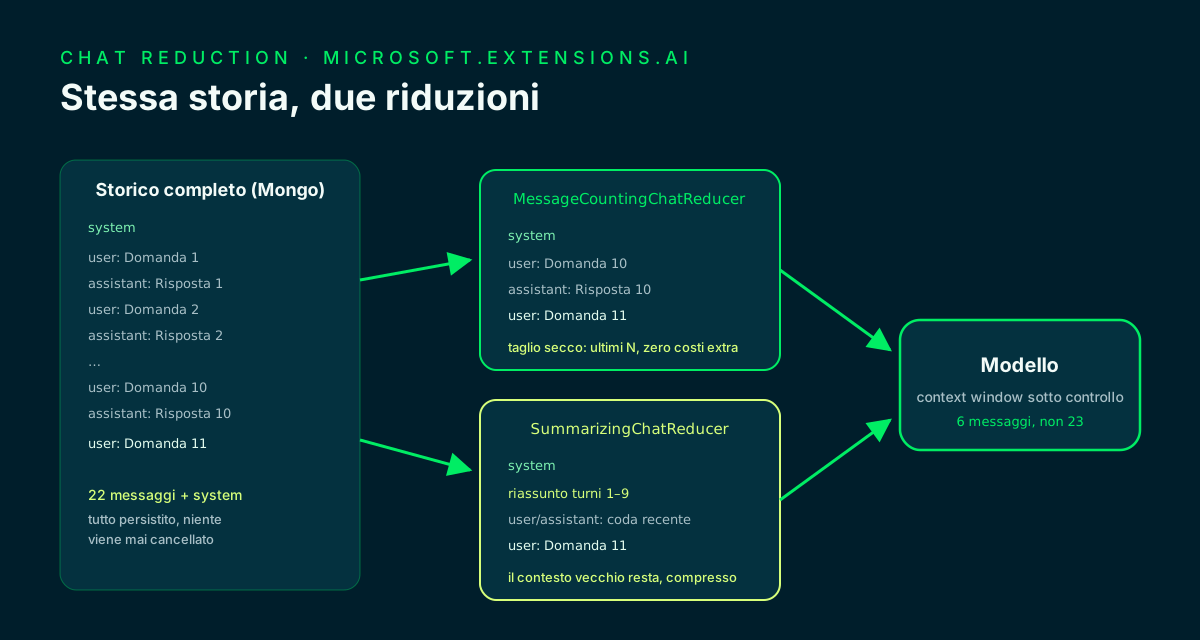
Counting cuts, summarizing compresses: either way the Mongo history stays whole.
🏭 The factory: strategy from configuration
The factory is the only place that knows the three strategies. The SummarizingChatReducer receives the same IChatClient as the chat: the summary is generated by the same local model, no extra dependency. In production I can point it at a smaller, faster model dedicated to summarization.
public sealed class ChatReducerFactory(IOptions<ChatMemoryOptions> options)
{
    // "counting" keeps the last N; "summarizing" folds older
    // turns into an LLM summary. Anything else = no reduction.
    public IChatReducer? Create(IChatClient chatClient) =>
        options.Value.Strategy.ToLowerInvariant() switch
        {
            "counting" => new MessageCountingChatReducer(
                options.Value.TargetMessageCount),
            "summarizing" => new SummarizingChatReducer(
                chatClient,
                options.Value.TargetMessageCount,
                options.Value.SummarizationThreshold),
            _ => null,
        };
}
SummarizingChatReducer · Microsoft Learn ↗
🔁 The core: load, reduce, ask, persist
The ChatService is the whole flow in four steps. Note the order: the reduction happens after recomposing the full prompt and before the model call; persistence saves the unreduced turn. The store doesn't even know a reducer exists.
The HTTP response carries three numbers that make the memory observable: how many messages the full history holds, how many reached the model, and a preview of the actual prompt. They're the difference between “I think it's summarizing” and watching it happen turn by turn.
// 1. Full prompt: system + persisted history + the new turn.
List<ChatMessage> fullPrompt =
[
    new(ChatRole.System, options.Value.SystemPrompt),
    .. conversation.Messages.Select(m =>
        new ChatMessage(new ChatRole(m.Role), m.Text)),
    new(ChatRole.User, request.Text),
];

// 2. Reduce: the store keeps everything, the model gets the reduced view.
var prompt = reducer.Value is null
    ? fullPrompt
    : (await reducer.Value.ReduceAsync(fullPrompt, ct)).ToList();

// 3. Ask the model — reduced prompt only.
var response = await chatClient.GetResponseAsync(prompt, cancellationToken: ct);

// 4. Persist the turn untouched (no reduction on write).
await repository.AppendMessagesAsync(conversationId, turn, ct);

return new SendMessageResponse(
    response.Text, fullPrompt.Count, prompt.Count, preview);
IChatReducer · Microsoft Learn ↗
🌐 Endpoints and wiring: Minimal API all the way
Three endpoints are enough: create a conversation, send a message, read the transcript back. The wiring in Program.cs registers Mongo, the OllamaApiClient as IChatClient via AddChatClient, the factory and the service — no Controllers, no ceremony.
builder.Services.AddSingleton<IConversationRepository,
    MongoConversationRepository>();

builder.Services.AddChatClient(sp =>
{
    var ollama = sp.GetRequiredService<IOptions<OllamaOptions>>().Value;
    return new OllamaApiClient(new Uri(ollama.Endpoint), ollama.Model);
});

builder.Services.AddSingleton<ChatReducerFactory>();
builder.Services.AddSingleton<ChatService>();

var app = builder.Build();
app.MapConversationEndpoints();   // POST /, POST /{id}/messages, GET /{id}
app.Run();
Minimal APIs · Microsoft Learn ↗
🐳 Dependencies in Docker: Mongo, Ollama and the model pull
Outside the app, two services are needed: MongoDB and Ollama. The repo's docker-compose.yml brings both up with healthchecks, plus a one-shot container that downloads llama3.2:3b into the Ollama volume and exits: the first start takes a few minutes (~2 GB), from the second on it's instant. Nothing gets installed on the laptop besides Docker.
appsettings.json already points at localhost:27017 and localhost:11434, the ports published by compose: docker compose up -d, dotnet run, and the chat answers.
services:
  mongodb:
    image: mongo:7
    ports: ["27017:27017"]
    volumes: [mongo-data:/data/db]

  ollama:
    image: ollama/ollama:latest
    ports: ["11434:11434"]
    volumes: [ollama-data:/root/.ollama]

  ollama-init:    # one-shot: pulls the model, then exits
    image: ollama/ollama:latest
    depends_on: { ollama: { condition: service_healthy } }
    environment: ["OLLAMA_HOST=http://ollama:11434"]
entrypoint: ["ollama", "pull", "llama3.2:3b"]🔬 Observable memory: the numbers on every reply
This is where the pattern shows its work. After a dozen turns the Mongo history is at 23 messages, but messagesSentToModel stays at 6: system, the reducer-generated summary, the recent tail and the new question. The promptPreview shows exactly what the model saw — including the summary message, recognizable because it condenses the early turns into one line.
In production these three fields become metrics: if messagesSentToModel grows without a ceiling, the reducer isn't working; if the summary drops information that mattered, I see it in the preview before users notice it in the quality of the answers.
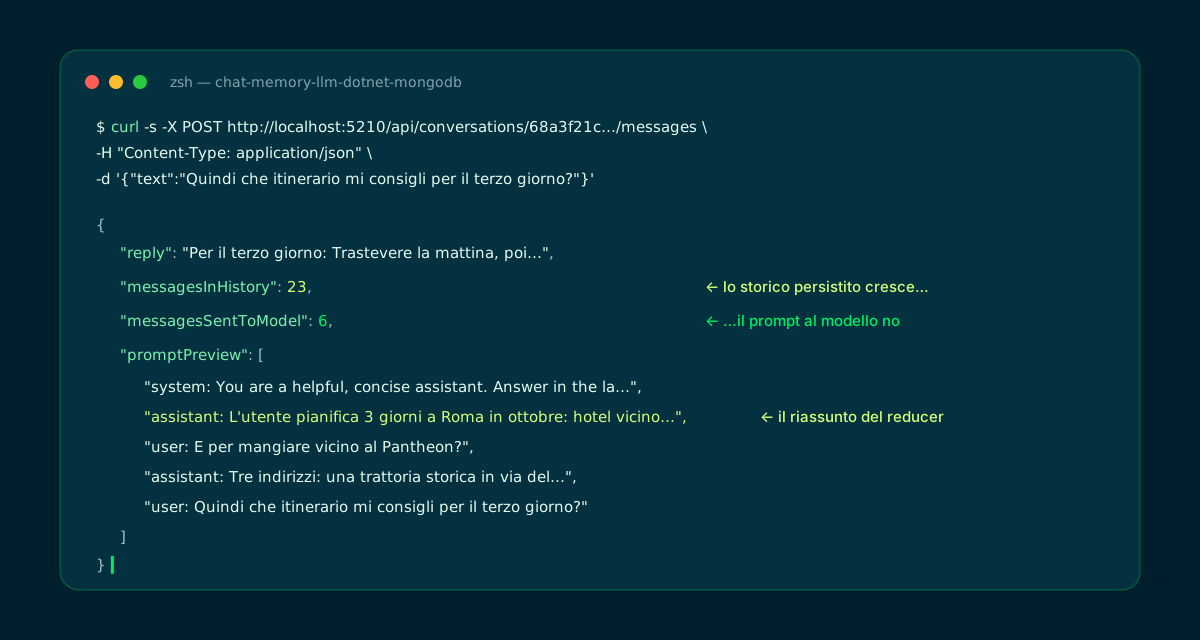
The yellow line in the promptPreview is the summary: the early turns compressed into one message.
🧪 Tests without Mongo and without Ollama
The reducers and the chat flow are testable without external services: a fake IChatClient with a scripted reply (which records the messages it received) and an in-memory repository. The most useful test verifies the pattern's central property: after the reduction the model saw 5 messages but the store keeps 22.
The fake doubles as the summarizer: when testing the SummarizingChatReducer, the summarization “LLM call” returns a fixed string and I can assert it lands in the reduced prompt. Six tests, seven milliseconds, zero containers.
var response = await service.SendAsync(
    conversation.Id, new SendMessageRequest("Latest question"), ct);

Assert.Equal(22, response.MessagesInHistory);   // system + 20 + new
Assert.Equal(5, response.MessagesSentToModel);  // system + last 4
Assert.Equal("Latest question",
    chatClient.LastMessages![^1].Text);         // the fake records everything

var stored = await repository.GetAsync(conversation.Id, ct);
Assert.Equal(22, stored!.Messages.Count); // the store keeps EVERYTHING⚠️ Limits and trade-offs to know
Chat reduction is experimental (MEAI001): the API may change across Microsoft.Extensions.AI releases — the full-store-plus-reduced-view pattern, though, stays valid even if tomorrow I write the reducer by hand. The SummarizingChatReducer excludes messages containing function calls from the summary: with tool calling, the “tools” part of the conversation doesn't get compressed.
The summary is itself an LLM output: it can drop details, and with a small model like llama3.2:3b it does. The practical defenses: a generous recent tail (high targetCount), a threshold that avoids constant re-summarizing, and an eye on the promptPreview when answers degrade. For hard requirements — “remember the order number mentioned 40 turns ago” — a summary isn't enough: that calls for semantic memory with embeddings and retrieval, the natural next step of this architecture.
- Experimental API: a deliberate NoWarn; the pattern is stable even if the API shifts.
- Lossy summaries: fine details can vanish; the preview surfaces it immediately.
- Summarizing cost: one extra LLM call when it triggers — the threshold amortizes it.
- Beyond summaries: precise long-term facts → embeddings + retrieval, not summarization.
📦 GitHub repo
All the article's code is in a public repository: the complete Minimal API (Mongo repository, reducer factory, chat service, endpoints), the six xunit tests with the fake IChatClient, the docker-compose.yml with Mongo, Ollama and the automatic model pull, plus a ready-to-use requests.http for the three endpoints.
Once cloned: docker compose up -d, dotnet run, and the first conversation with memory is one curl away. The strategy changes from appsettings.json without touching code.
$ git clone https://github.com/fscamuzzi/chat-memory-llm-dotnet-mongodb.git
$ cd chat-memory-llm-dotnet-mongodb

$ docker compose up -d        # Mongo + Ollama + pull llama3.2:3b
$ docker logs -f chatmemory-ollama-init   # first start: ~2 GB

$ dotnet test                 # 6 tests, zero external services
$ dotnet run --project src/ChatMemory.Api

$ curl -s -X POST http://localhost:5210/api/conversations \
    -H "Content-Type: application/json" -d '{"title":"Rome"}'
chat-memory-llm-dotnet-mongodb · GitHub ↗
✅ Final checklist: memory in six moves
Recapping the journey. The rule I take home: the store and the prompt are two different things — the former is the complete truth and never gets reduced, the latter is a throwaway projection I keep small with the right reducer for the use case. Everything else — strategy, thresholds, model — is configuration.
- 01History in Mongoone document per conversation, $push per turn
- 02Prompt rebuiltsystem + history + new message, every turn
- 03Reducer in betweencounting or summarizing, from appsettings.json
- 04Local modelOllama via OllamaSharp as IChatClient
- 05Observable replymessagesInHistory vs messagesSentToModel
- 06Tests with a fakescripted IChatClient, no containers in tests
Frequently asked questions about LLM chat memory
What is an IChatReducer in Microsoft.Extensions.AI?
It's an interface with a single operation, ReduceAsync, that takes a conversation's message list and returns a shorter version to send to the model. The library ships two implementations: MessageCountingChatReducer, which keeps system messages plus the last N, and SummarizingChatReducer, which folds older turns into an LLM-generated summary. The API is marked experimental (MEAI001).
MessageCountingChatReducer or SummarizingChatReducer — which one?
It depends on how much the old context matters. Counting is free and predictable: perfect when distant turns are no longer relevant (operational support, commands). Summarizing costs an LLM call when it triggers but preserves the gist of the conversation: right for long chats where “what we said at the start” stays relevant. In the project the strategy is configuration, so you can switch and measure without touching code.
Can the SummarizingChatReducer's summary lose information?
Yes: it's an LLM output, hence lossy by nature, and with small models the loss is more visible. The defenses are a generous recent tail, a threshold that avoids re-summarizing on every turn, and observability of the actual prompt to spot gaps immediately. For precise facts that must be remembered long-term, the right tool is semantic memory with embeddings and retrieval, not a summary.
Why store the full transcript in MongoDB if the model only sees part of it?
Because the store and the prompt have different responsibilities. The full transcript serves audit, debugging, the user interface and rebuilding the prompt with any future strategy; the reduction is just a read-side view built at call time. Reducing the store as well would be an irreversible data loss to save bytes MongoDB handles without breaking a sweat.
Let's talk
If this topic is relevant to you, write to me: comparing notes on code and AI is always time well spent.


